
July 2017
L’ACTIVITÉ ARCHÉOLOGIQUE « À LA DÉCOUVERTE DU FORT D’ODANAK ! » (In French only)
 Du 1er au 31 août 2017, une vague archéologique submerge l’ensemble du Québec, avec son lot de découvertes, de nouveautés et d’émerveillements! Le Mois de l’archéologie vous propose plus d’une centaine de visites, d’entretiens, de fouilles archéologiques et d’activités des plus ludiques dans des lieux archéologiques et historiques aux quatre coins de la province. À travers 15 régions du Québec, plus de 40 archéologues et spécialistes pourront partager avec vous leurs recherches et vous éclairer sur l’histoire qui dort sous nos pieds. Profitez du Mois de l’archéologie pour fouiller des sujets qui vous passionnent et déterrer les secrets de nos ancêtres!
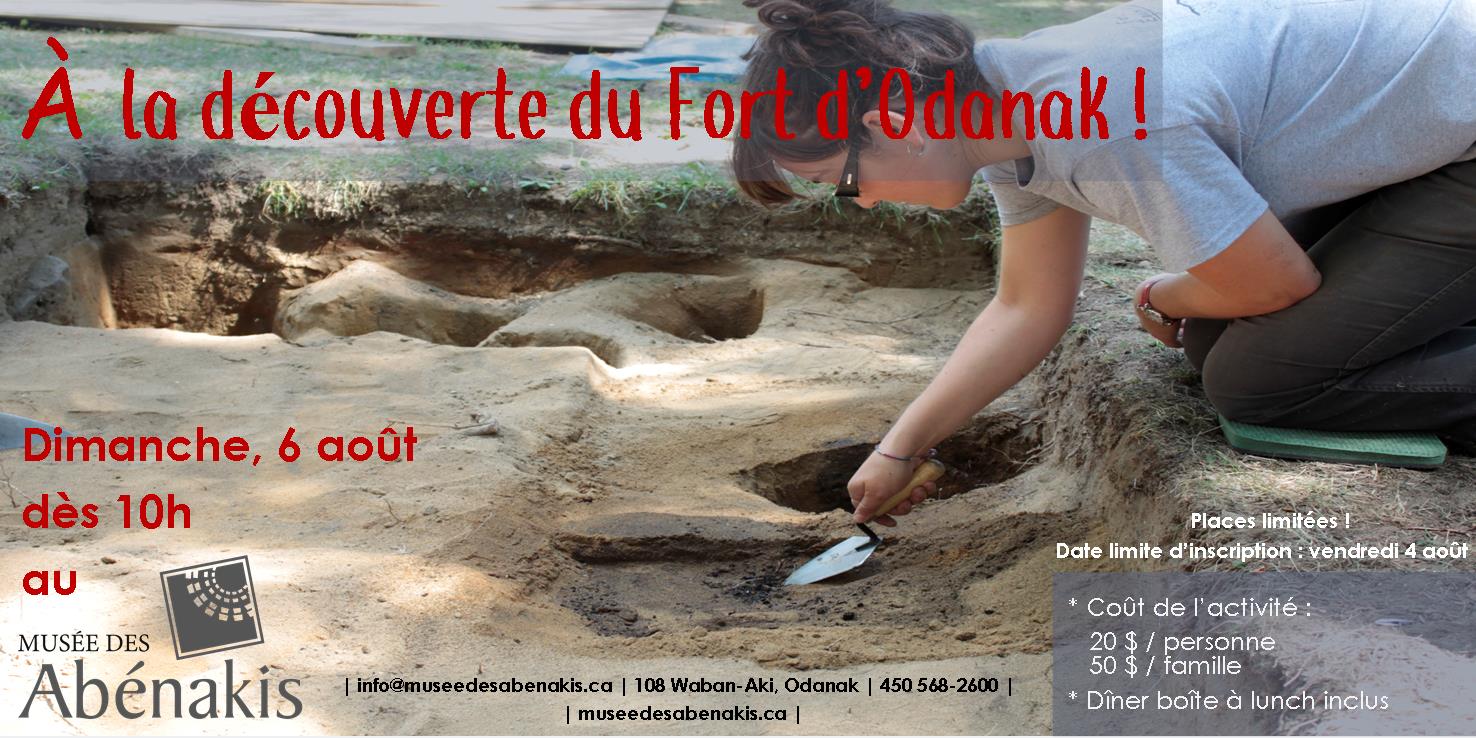
Une véritable expérience archéologique vous est offerte, le 6 août de 10 h à 14h au Musée des Abénakis lors d’une activité qui captivera petits et grands ! L’activité « À la recherche du Fort d’Odanak » vous invite à découvrir les ficelles du métier d’archéologue en participant activement à une séance de fouilles archéologiques au cœur même du Fort d’Odanak. En compagnie de l’archéologue Geneviève Treyvaud, apprenez-en plus sur les techniques de fouilles et partez à la recherche d’artéfacts ! Sur l’heure du diner, assistez à une conférence qui présentera les résultats des dernières recherches effectuées en territoire abénakis ! Le tarif pour participer à cette journée haute en couleur, qui inclut également le diner de type boîte-lunch, est de 20 $ par personne ou de 50 $ par famille. Les places sont limitées, inscrivez-vous dès maintenant au 450 568-2600 ou par courriel au groupes@museedesabenakis.ca.
Afin d’en connaître davantage sur la programmation de tous les lieux participants, visitez le www.moisdelarcheo.com ou adhérez à la page Facebook du Mois de l’archéologie.
Le Mois de l’archéologie est une réalisation du réseau Archéo-Québec.
Information: 1-514-872-7720 ou info@archeoquebec.com
Elle est rendue possible grâce à la collaboration d’un partenaire majeur, le Ministère de la Culture et des Communications du Québec.
UPDATE – DESCHENEAUX CASE
On August 3, 2015, Madam Justice Chantal Massse of the Québec Superior Court ruled in the Descheneaux case that most of the registration rules in the Indian Act are invalid because they discriminate on the basis of sex when granting “Indian status” and therefore violate the Canadian Charter of Rights and Freedoms.
However, Justice Masse suspended the effect of her declaration of invalidity for 18 months in order to giver Parliament time to amend the Indian Act and make it compliant with the Charter.
Justice Masse’s decision did not give anyone a new right to status: instead, she ruled it was up to Parliament and not the Court to change the Indian Act. If Parliament did not act before the deadline, registration under the Indian Act would simply cease for almost everyone.
The government finally introduced its proposed amendments in the Senate in late October 2016, entitled Bill S-3, but the Senate Committee on Aboriginal Peoples asked the Minister of Indian and Northern Affairs to conduct better consultation and eliminate all sex discrimination from the registration rules.In January 2017, the government obtained an extension of its deadline to July 3rd from Justice Masse, but only presented its revised amendments to the Senate in May 2017.
The Senate decided Bill S-3 does not go far enough and on June 1st adopted amendments – referred to as “6(1)(a) all the way” – that would give the same status to all descendants of a woman who lost her status if they were born before the new rules came into effect in 1985. However, the Minister said she would oppose this change when Bill S-3 came before the House of Commons.
After the Minister’s lawyers told Justice Masse that they would not use the June 19th hearing date set aside for a motion to extend the suspension, the lawyers for Stéphane Descheneaux, Susan and Tammy Yantha and the Abenaki brought their own motion. On June 20th, Justice Masse refused to grant the extension, ruling that the court could not become involved in dispute between the House of Commons and the Senate.
On June 21st, the House of Commons adopted Bill S-3 without the “6(1)(a) all the way” amendments and sent it back to the Senate, but on June 22nd, the Government Representative in the Senate adjourned debate on Bill S-3 and both the House of Commons and the Senate adjourned for the summer.
In the last week of June the government presented its own motion and asked Justice Masse to extend the suspension of her declaration of invalidity till December 26, but Justice Masse ruled on June 27th that nothing had changed since her previous decision and denied Canada’s motion.
The government filed an appeal on the issue of extending the suspension, which will be heard in Montreal on August 9th. Until then, a safeguard order issued by Justice Nicholas Kasirer of the Québec Court of Appeal – with the consent the lawyers for Descheneaux, the Yanthas and the Abenaki – allows the Registrar to continue to apply the existing registration rules in the Indian Act.
REDÉCOUVRIR UN HÉRITAGE TROP PEU CONNU (in French only)
 Le Centre communautaire Saint-Pierre (CCPS) organise, dans le cadre du 150eanniversaire du Canada, une semaine de sensibilisation à la culture autochtone du 31 juillet au 3 août au presbytère de l’église Saint-Pierre, à Drummondville.
C’est grâce à une subvention de 23 160 $ du gouvernement du Canada que le projet a pu voir le jour. «Pendant quatre jours, les citoyens vont acquérir une grande ouverture d’esprit et de respect mutuel à la suite de ces rencontres. Ça leur permettra de découvrir l’histoire, les mœurs et la vie quotidienne des autochtones», a avoué Florence Benedicte du Conseil de bande des Abénakis d’Odanak.
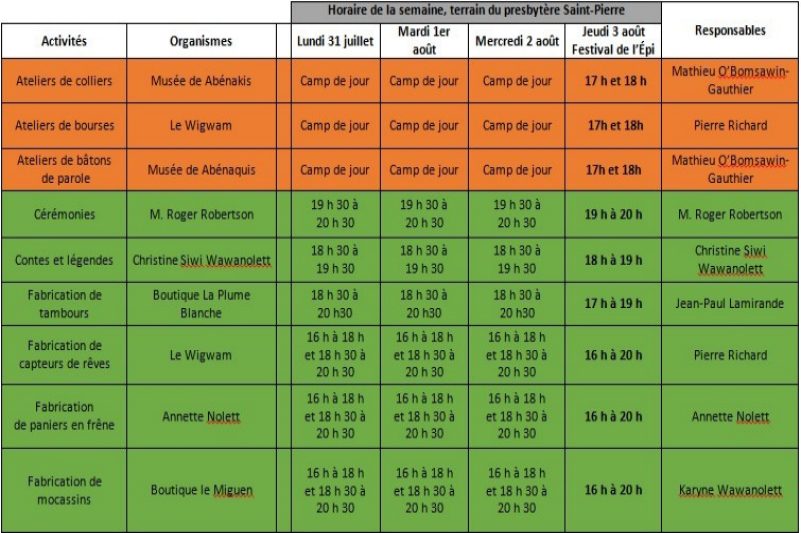
La programmation comporte deux volets qui sont offerts gratuitement aux participants. Le premier, destiné aux 400 enfants qui fréquentent les camps de jour, fera découvrir l’artisanat amérindien par la fabrication de colliers, de bourses et de bâtons de parole. L’animation sera faite par le Musée des Abénakis et la boutique Le Wigwam.
Le second volet s’adresse à toute la population. À partir de 16 h tous les jours les participants pourront assister à des démonstrations de fabrication de tambours, de capteurs de rêves, de paniers et de mocassins. En soirée, dès 18 h 30, les contes et légendes amérindiennes, animés par Christine Siwi Wawanolett, feront découvrir un tout autre univers de la tradition amérindienne. De plus, tous les soirs, une cérémonie du Grand Conseil se tiendra à partir de 19 h 30. Cette cérémonie avait lieu avant les séances du Grand Conseil pour préparer le corps et l’esprit afin qu’ils puissent prendre les meilleures décisions pour la communauté. Pour clôturer cette cérémonie, il y aura une signature d’un traité de paix pour tous les peuples de la terre. Roger Robertson, représentant de la nation Micmac, animera la cérémonie.
Le 3 août, journée du 45e anniversaire du Festival de l’épi du CCSP, de 16 h à 20 h, les enfants de Drummondville pourront participer aux ateliers d’artisanat amérindien. De plus, tous les ateliers de fabrication les contes et légendes et la cérémonie du Grand Conseil seront également tenus lors de la soirée du Festival de l’épi. Les objets fabriqués dans le cadre des ateliers du soir feront l’objet d’un tirage à la fin de chacune des soirées.
«Kwaï (Bonjour en Abénakis). Le peuple Abénakis est fier et accueillant. Une trentaine d’enfants visiteront le Musée des Abénakis à Odanak afin de faire découvrir notre culture. Nous sommes heureux de participer à cette semaine de sensibilisation à la culture autochtone», a conclu Mathieu O’Bomsawin-Gauthier, directeur général du musée.
June 2017
The Government of Canada Recognizes the National Historic Significance of the Abenaki Migrations to New France (1675-1748)
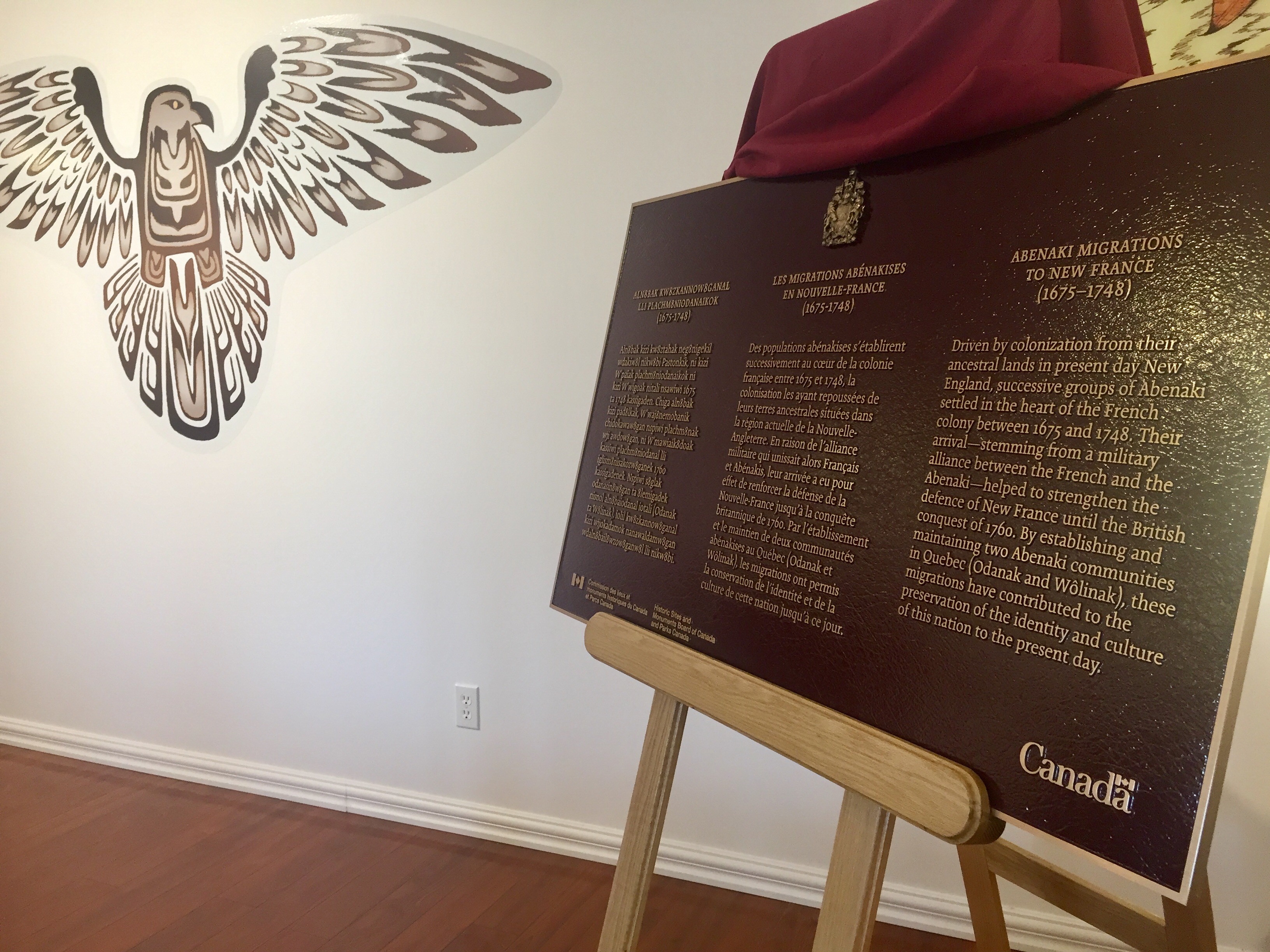 Canada’s national historic sites, national parks and national marine conservation areas enable Canadians to experience their rich and varied history in a special way and play a big part in the celebration of Canada 150.
Today, Parks Canada and the Historic Sites and Monuments Board of Canada recognized the national historic significance of the Abenaki migrations to New France (1675-1748). A special ceremony took place at the Petite Chapelle Sainte-Thérèse of Wôlinak with members of the Historic Sites and Monuments Board of Canada, the Wôlinak Band Council and the Odanak Band Council.
The Government of Canada is committed to connecting Canadians to the significant people, places, and events that contributed to our country’s diverse heritage. From 1675 to 1748, the Abenaki migrations ensured the survival of those populations who chose to settle in the heart of the French colony after having been evicted from their ancestral lands in New England. The settlements of Saint-François (Odanak) and Bécancour (Wôlinak) thus became places of refuge for hundreds of those people.
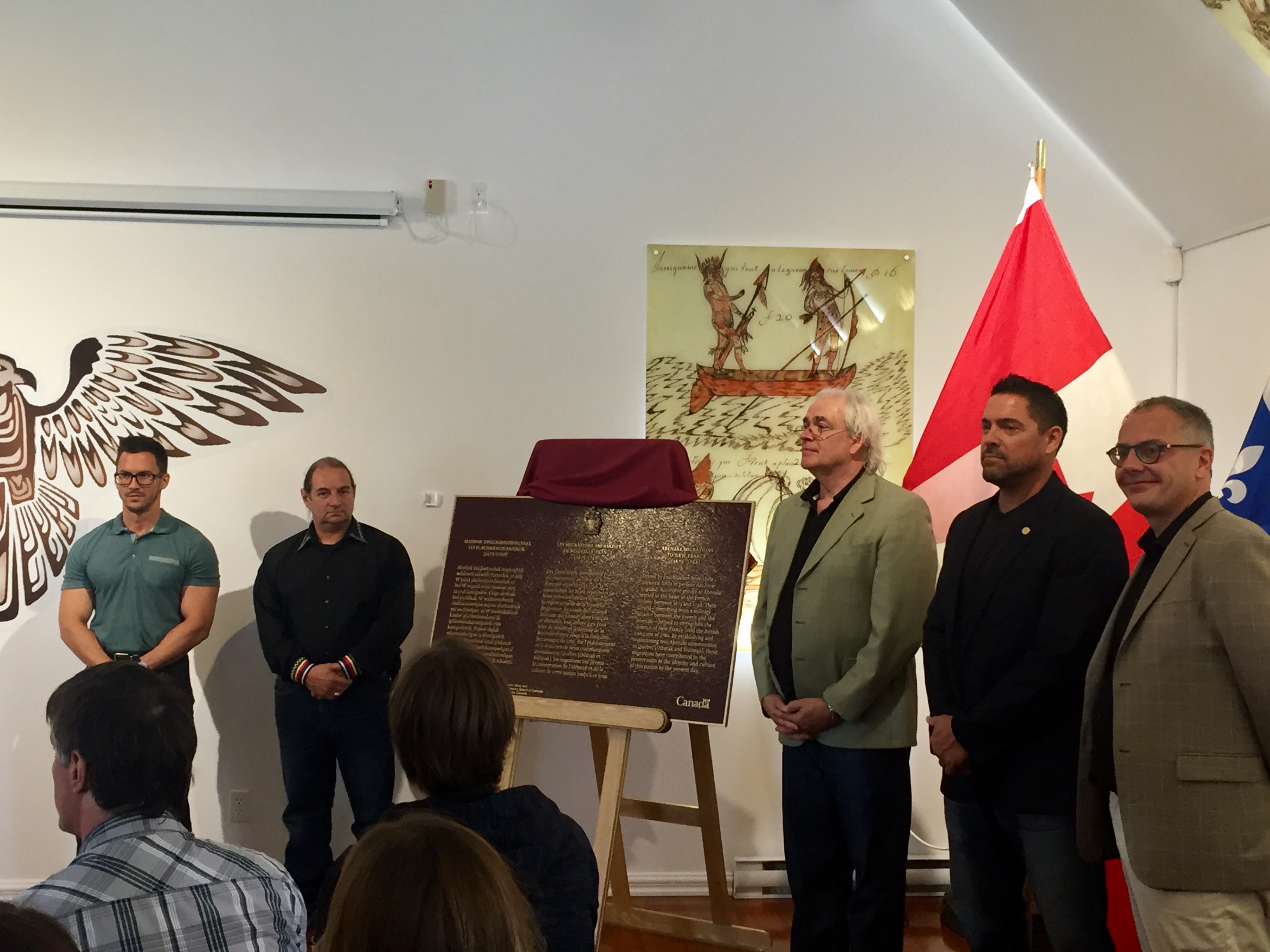
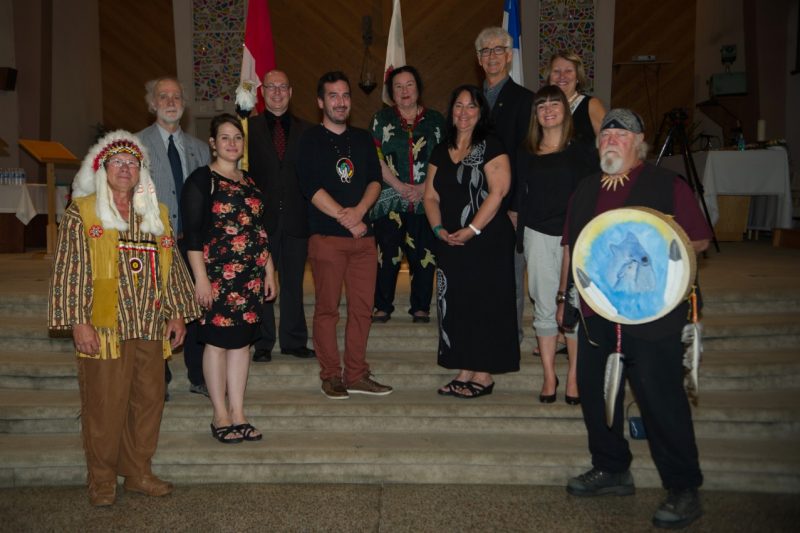
Dave Bernard, Executive Director of the Abenaki of Wôlinak Council; Rick O’Bomsawin, Chief of Odanak; Mario Marchand, historian; Denys Bernard, Excutive Director of the Grand Conseil de la Nation Waban-Aki and Nicholas Roquet, Quebec representative to the Historic Sites and Monuments Board of Canada
Helping the French during numerous incursions, the Abenaki accepted an offer of neutrality by the British following the French defeat in 1760. In doing so, they lost their lands located in New England. By establishing and sustaining two Abenaki communities in Quebec, those migrations helped preserve the Abenaki identity and culture to the present day.
The Government is committed to reconciliation and nation-to-nation relationships with Indigenous Peoples, based on recognition of rights, respect, co-operation, and partnership.
This year, as we celebrate Canada 150, we have an opportunity to bring all Canadians together, create new connections between Indigenous and non-Indigenous Canadians and foster discussions on the stories, cultures, and realities of Indigenous communities.
As part of the centennial of national historic sites, Parks Canada invites Canadians to be inspired and captivated by the stories of the people, places, and events that shaped the Canada of today.
Take advantage of free admission to national historic sites in 2017, and discover truly Canadian places and stories!
Quote
“The Government of Canada is very pleased to commemorate the national historic significance of the Abenaki migrations to New France from 1675 to 1748. Through the Odanak and Wôlinak settlements, the Abenaki culture is still alive and continues to flourish. As part of the 150th anniversary of our great nation, it is important for all of us to learn more about the people, places, and events that have shaped our rich cultural heritage.”
– The Honorable François Philippe Champagne, Minister of International Trade and Member of Parliament for Saint-Maurice—Champlain
Quick Facts
When the Abenaki left their ancestral lands, they originally settled in the vicinity of Lake Champlain, Lake Megantic, Chambly, along the Bécancour, Chaudière and Saint-François rivers, as well as on the shores of the St. Lawrence at Sillery where they could survive by engaging in traditional hunting and fishing.
The arrival of the Abenaki contributed to strengthening the defence of New France until the British conquest in 1760.
Created in 1919, the Historic Sites and Monuments Board of Canada advises the Minister of Environment and Climate Change regarding the national historic significance of places, people, and events that have marked Canada’s history.
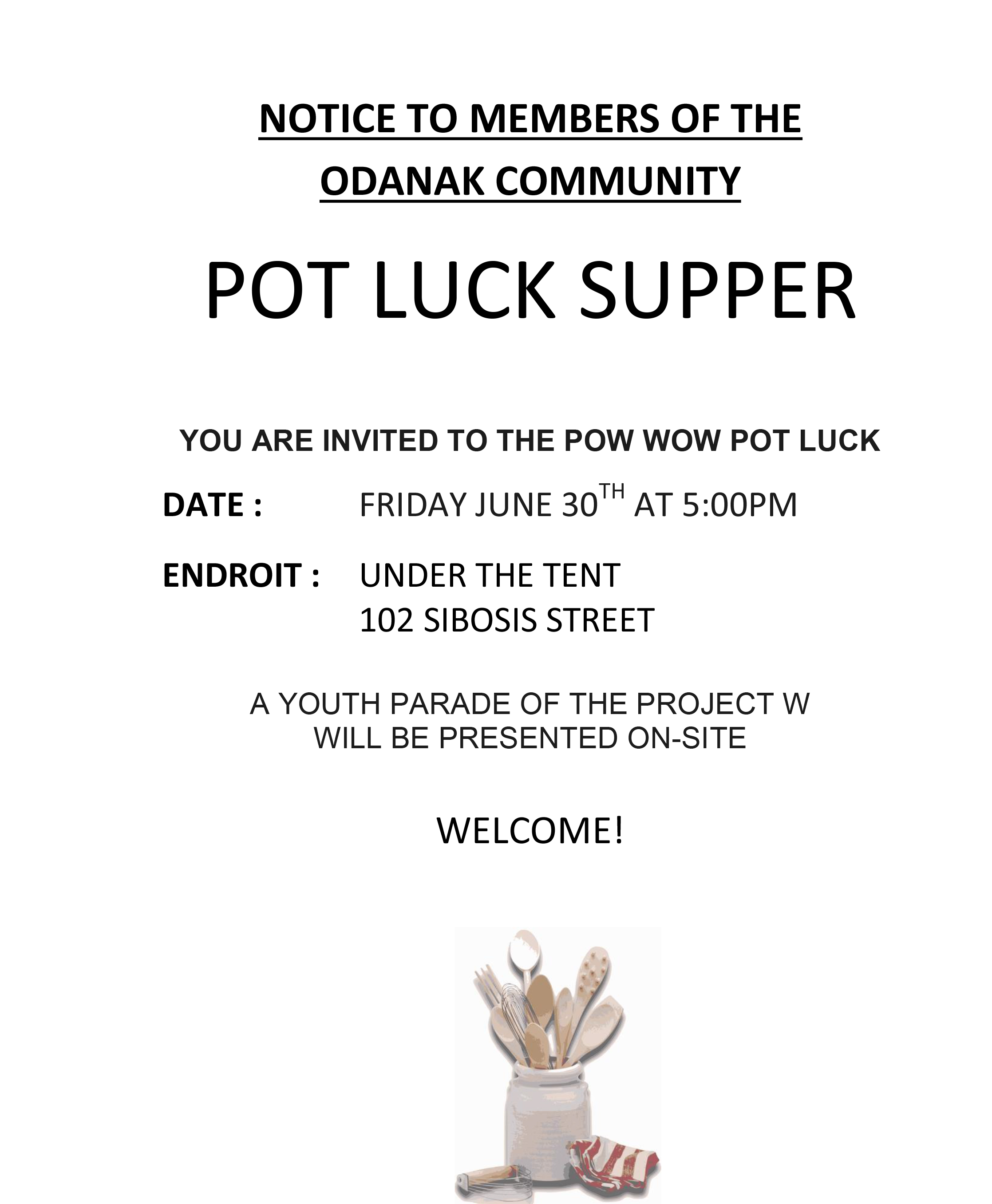
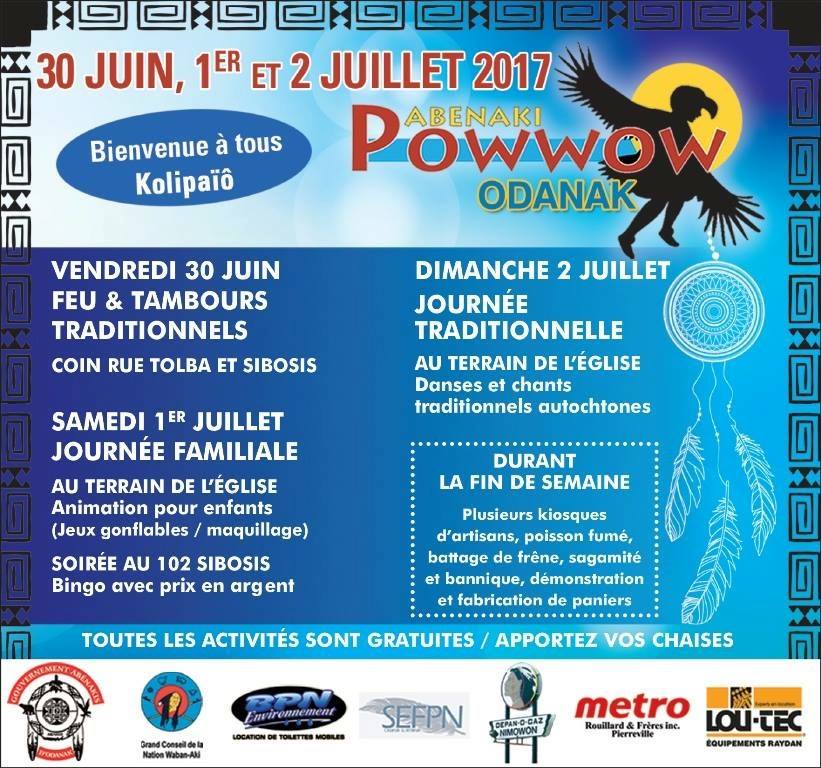
PROGRAM | POW WOW 2017
Here’s the program of the 2017 edition of the Odanak Pow Wow.
Hope to see you there!
JUSTICE MASSE RELIES ON ASSUMPTION THE GOVERNMENT WILL COMPLY WITH THE CONSTITUTION
The Québec Superior Court today dismissed a motion to extend Parliament’s deadline for eliminating sex discrimination from the registration provisions in the Indian Act, however Justice Chantal Masse emphasized that she remains available to hear another motion for an extension before the deadline expires on July 3rd, effectively giving the government and the Senate time to reach agreement on a contentious bill.
Read the complete press release HERE.
MINISTER JODY WILSON-RAYBOULD GIVES UP ON ELIMINATING THE DISCRIMINATION AGAINST FIRST NATIONS WOMEN
Federal Justice Minister Jody Wilson-Raybould no longer wants to fix all sex discrimination in the Indian Act registration rules, even though in 2010, Chief Jody Wilson-Raybould told Parliament “to eradicate discrimination wherever and whenever possible.”
Read the complete press release HERE.
A FIRST ABENAKISE JUDGE
The Abenaki Council of Odanak would like to congratulate Mrs O’Bonsawin on being the first Abenakise Judge.
Previously general counsel with the Royal Ottawa Health Care Group in Ottawa, Mrs O’Bonsawin is appointed a judge of the Superior Court of Justice in Ottawa.
BIOGRAPHY
 Justice Michelle O’Bonsawin was born in Hanmer, Ontario, a small Francophone town east of Sudbury. She is a fluently bilingual Abenaki member of the Odanak First Nation. Justice O’Bonsawin holds a B.A. (Laurentian University), an LL.B. (University of Ottawa), and an LL.M. (Osgoode Hall), and is currently enrolled in the University of Ottawa’s Ph.D. program in law. She began her legal career with the RCMP Legal Services and later was counsel with Canada Post Corporation, specializing in labour, employment, human rights, and privacy law. Prior to her appointment, Justice O’Bonsawin was general counsel for the Royal Ottawa Health Care Group, where she developed a specialization in mental health law. She has taught Indigenous law part-time in the University of Ottawa’s French common law program.
In addition to her legal work, Justice O’Bonsawin is a frequent guest speaker on mental health, labour and privacy law. She serves on the Board of Governors of the University of Ottawa, as well as its Executive Committee. Justice O’Bonsawin also acts as a mentor in the Canadian Bar Association, Ontario Bar Association, and University of Ottawa mentorship programs and is the legal coach for the Collège catholique Samuel-Genest high school team for the OBA/OJEN moot competition. She resides in Ottawa with her family.
It is with great pride that we wish her all the best in her new function.
Letter – Bill S-3 and Eliminating Sex-based Inequities in Indian Act Registration
CLICK HERE TO READ THE FULL VERSION OF THE LETTER WRITTEN BY THE CHIEF RICK O’BOMSAWIN.
May 2017
Canada 150 : la richesse des cultures autochtones sera au cœur des célébrations (in French only)
Le gouvernement du Canada appuie deux nouveaux projets communautaires sur les cultures autochtones au Québec.
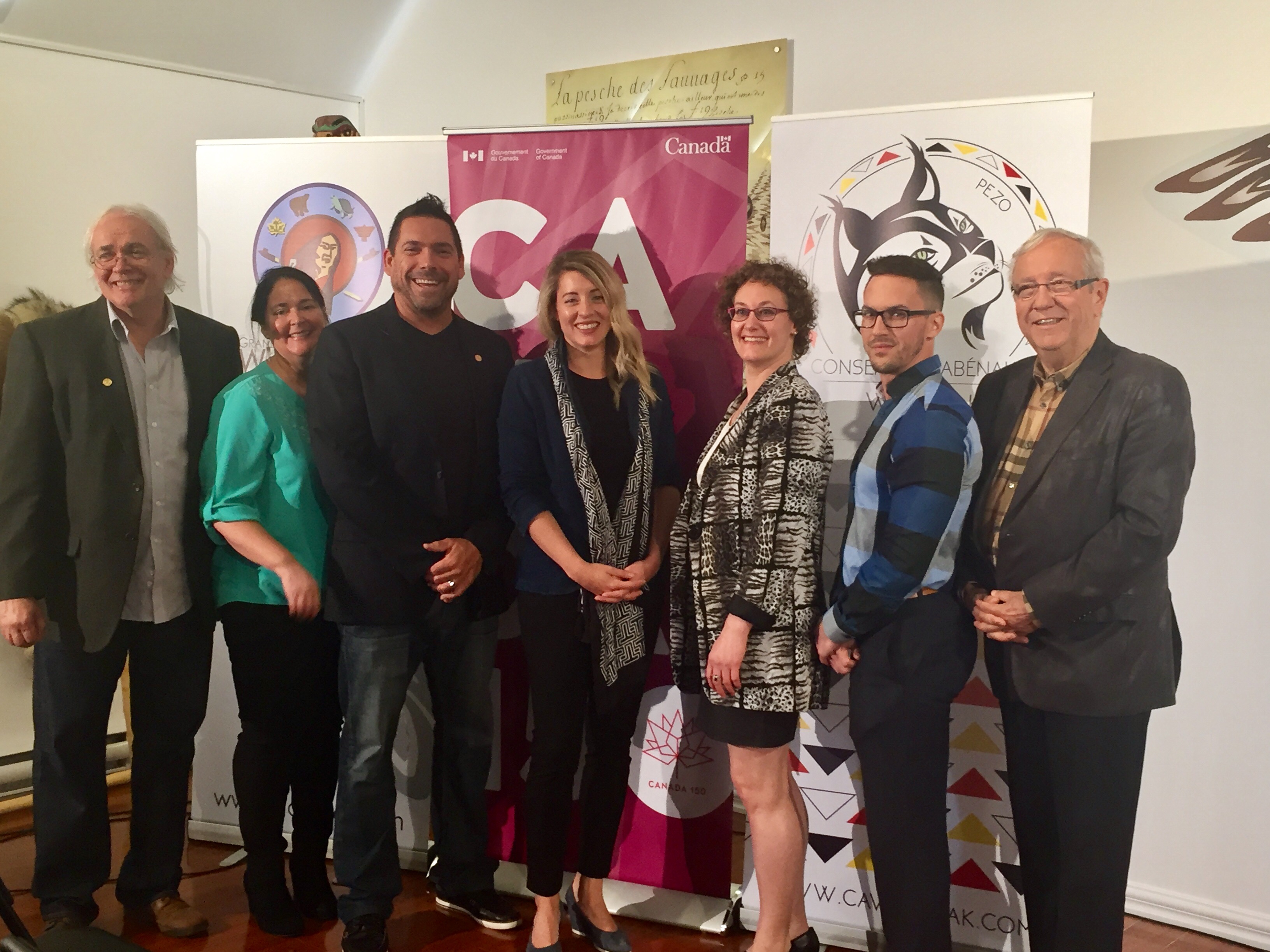
De gauche à droite: M. Mario Marchand, Mme Florence Benedict, M. Denys Bernard, Mme Mélanie Joly, Mme Anne Bishoff, M. Dave Bernard et M. Louis Plamondon
C’est à Wôlinak que l’honorable Mélanie Joly, ministre du Patrimoine canadien, a annoncé le 26 mai dernier le financement de deux nouveaux projets communautaires qui souligneront la richesse des cultures autochtones au Québec dans le cadre de Canada 150.
Le Conseil des Abénakis de Wôlinak a reçu près de 151 000$ pour son projet d’exposition intitulée « Mémoire vivante, la rivière au long détour » soulignant la place d’accueil et le lieu de mémoire de la mission Bécancour/Wôlinak. L’histoire des Abénakis sera, entre autres, mise en valeur par la réalisation de murales figuratives, d’une projection multimédia et d’une exposition d’artéfacts historiques tout au long de la saison estivale, et ce, dès le 21 juin prochain. « Avec l’exposition “Mémoire vivante, la rivière au long détour”, notre communauté retrouve sa place dans la grande histoire des Premières Nations ainsi qu’à Bécancour. » se réjouit M. Michel R. Bernard, chef du Conseil des Abénakis de Wôlinak.
Le Centre communautaire Saint-Pierre, quant à lui, a reçu un montant de 23 160$ pour l’aménagement d’un campement autochtone extérieur situé à proximité de ses installations, et ce, du 31 juillet au 3 août 2017, en collaboration avec le Conseil des Abénakis d’Odanak. En plus de faire connaître la culture autochtone et de favoriser un rapprochement culturel, ce projet initie les jeunes et les familles non autochtones à l’art et à la culture autochtones par la tenue de diverses activités. Comme le mentionne M. Gilbert Fafard, coordonnateur communautaire au Centre communautaire Saint-Pierre « Le campement autochtone extérieur que nous aménagerons en collaboration avec le Conseil des Abénakis d’Odanak permettra le rapprochement culturel entre les Autochtones et les non-Autochtones de la région de Drummondville et du Centre-du-Québec. En plus de favoriser une meilleure connaissance de notre passé et des mœurs des communautés autochtones du Québec, une telle activité nous donne l’occasion de mieux entrevoir notre avenir commun dans le Canada de demain. »
« Aucune relation ne compte plus aux yeux du gouvernement du Canada que celle qu’il entretient avec les peuples autochtones » souligne l’honorable Mélanie Joly, ministre du Patrimoine canadien,  « C’est pourquoi nous sommes fiers d’appuyer ces deux nouveaux projets communautaires qui permettront aux Canadiens de découvrir toute la richesse et l’histoire des cultures autochtones. Profitons de Canada 150 pour resserrer les liens qui nous unissent afin de léguer un bel héritage aux générations à venir. »
Il est important de rappeler que le gouvernement du Canada a accordé ces financements par l’entremise de Fonds Canada 150. Grâce à ce Fonds, le gouvernement appuie la tenue d’activités tant à l’échelle locale que nationale pour que les Canadiens d’un bout à l’autre du pays soient de la fête et ainsi faire de 2017 une année mémorable.
THE WABAN-AKI PILASKW – MAY EDITION IS NOW ONLINE
Hi everyone,
The last edition of the Waban-Aki Pilaskw newspaper is now available online. To take a look a it, CLICK HERE. Enjoy your reading!